Telecommunications and 6G research
Curiosity about how communication will evolve.
My research foundation is in wireless communications. Advances in machine learning, artificial intelligence and large language models have renewed my interest in semantic communications, 6G systems and programmable intelligent networks.
Past foundations
Research themes I have worked on.
MU-MIMO scheduling in RoF-based Fi-Wi indoor networks
Distributed antenna systems for indoor wireless coverage
Energy efficient RoF-based Fi-Wi indoor networks
Future research questions
Where curiosity is pointing next.
Topics below are presented as areas of active curiosity.
Semantic communications
- Topic
Classical wireless systems, as framed by Shannon, treat communication as a reconstruction problem: the goal is to reproduce the transmitted bits at the receiver as faithfully as possible, with no regard for what those bits mean. Semantic communication reframes this. The transmitter and receiver become a "teacher" and an "apprentice". The teacher identifies the meaningful, semantic content in the data and represents it minimally, and the apprentice reasons over that representation to regenerate the content using its own computing resources, rather than simply decoding a bitstream. Attaining this requires a shift away from today's data-driven and information-driven networks, which remain tied to raw data and discrete metrics, towards knowledge-driven and reasoning-driven networks that exploit accumulated knowledge, causal structure and generalizable AI to do more with less, which matters for the stringent reliability and latency demands of 6G and beyond.
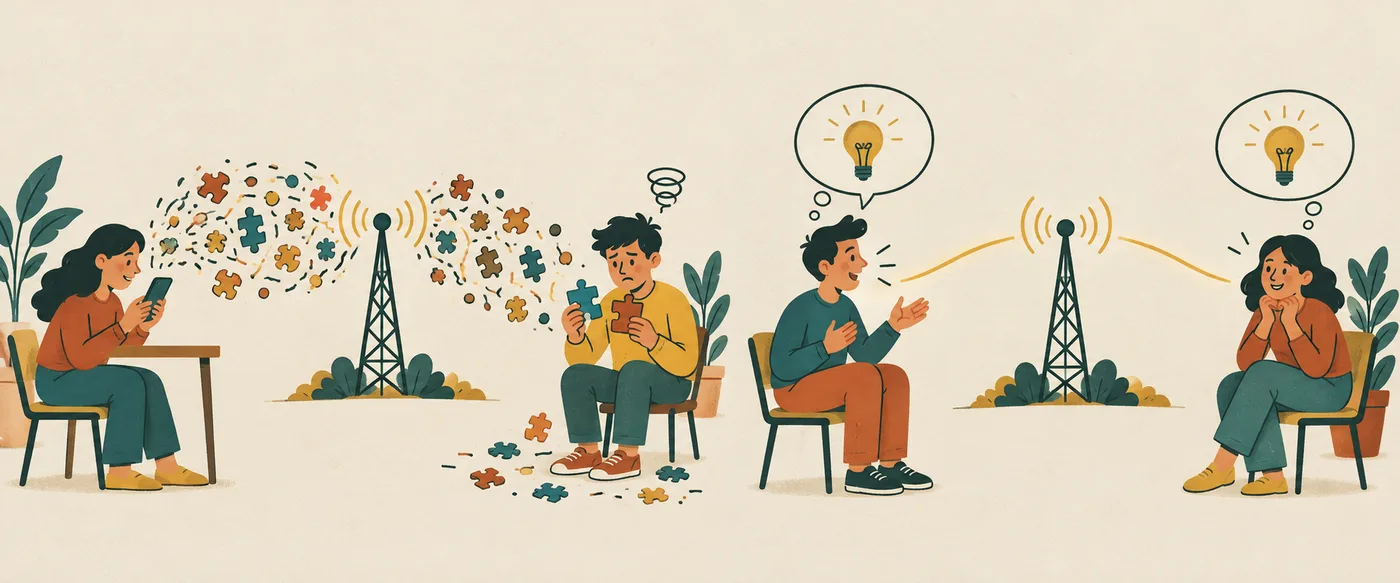
A classical system moves bits without meaning, leaving the receiver to reconstruct them piece by piece; a semantic system moves a shared understanding, so the apprentice grasps the idea directly.
- Research question
The paper by Chaccour et al. asks fundamental questions that can be best summarized as:
- How do we extend classical information theory to capture semantic information?
- Why do we need a semantic language, and how is it different from a natural language?
- How do we semantically process data, and how can we build a semantic language?
- How do we move from data-driven intelligence towards knowledge-driven reasoning?
- How do we evaluate the performance of semantic communication systems?
- How do we scale semantic communication systems to current and future large-scale cellular communication networks?
- Arxiv link
- arXiv:2211.14343
Questions drawn from C. Chaccour, W. Saad, M. Debbah, Z. Han and H. V. Poor, "Less Data, More Knowledge: Building Next Generation Semantic Communication Networks," arXiv:2211.14343, 2022.
Patent landscape
From a trickle of filings to a wave.
Curious how quickly the idea was moving from papers into patents, I pulled semantic communication filings from the EPO Technology Intelligence Platform , which exposes the PATSTAT database, and worked through them in a Jupyter notebook. What follows is a short read of about 1,150 applications filed between 2009 and 2025.
A field that turned a corner around 2020
For a decade this was a quiet corner of the literature: fewer than twenty filings a year right through 2018. Then it moved. Filings grew roughly ninefold between 2020 and 2024, and almost nine in every ten applications in the whole dataset were filed from 2021 onwards. Whatever else semantic communication is, it is no longer only a theoretical conversation.
Applications filed worldwide per year. 2026 is omitted, as no filings appear for it yet. Read the last bar with care
The apparent fall in 2025 is almost certainly an artefact rather than a downturn. Applications are generally published eighteen months after their filing date, so the most recent year in any PATSTAT extract is always undercounted: a good share of 2025's filings simply had not surfaced when this data was pulled. The honest reading is that 2024 and 2025 are both near the top of a steep curve, and that the 2025 figure will rise.
Who is actually filing
The applicant list is striking for how academic it is. Beijing University of Posts and Telecommunications alone accounts for more than a hundred applications, and universities and public laboratories take most of the leading positions, with Huawei, LG Electronics and Apple the notable corporate entries. A field whose patents are filed largely by universities is typically still close to the research frontier rather than settled into products, which fits a technology whose foundations are still being argued over in the literature.
Leading applicants. Highlighted bars are companies; the rest are universities and public research laboratories. Filed as artificial intelligence, not as radio
The classification data makes the same point the research literature does. The most common CPC subclass across these filings is G06N, which covers artificial intelligence and machine learning, ahead of the transmission and wireless subclasses H04L and H04W. Drafters are presenting these inventions as computing and reasoning inventions that happen to run over a network, rather than as incremental improvements to a radio link. That is precisely the shift from data-driven to knowledge-driven networks described above.
Most frequent CPC subclasses. Applications carry several codes each, so these counts overlap. A thin European footprint
The detail that stands out from where I sit is how little of this reaches the European Patent Office. Across the whole period the dataset holds only seventeen EPO filings, peaking at four in a single year. Set against more than a thousand applications worldwide, European protection for this technology is currently very thin, whether because filing strategies are still domestic, or because it is simply early.
Geography should be read cautiously. Country information is incomplete in this extract, so these recorded counts are a view of the selected countries shown, not a reliable global ranking or a share of all filings.
Selected applicant-country counts from the extract. Country coverage is incomplete. Data: EPO Technology Intelligence Platform (TIP) , PATSTAT, filing years 2009 to 2025, retrieved 11 October 2026. PATSTAT (Patent Statistical Database) is the EPO's global patent database covering more than 100 patent authorities worldwide; it is the standard reference for quantitative patent research and is freely accessible via TIP with an EPO account. Counts here reflect a keyword-based search for semantic communication and will not be exhaustive. Recent years are undercounted because of the eighteen-month publication delay. This is a personal exploration of public patent data and is not legal advice or a professional search.
AI native 6G networks
The question I am most curious about is whether AI can be embedded natively into the 6G network architecture — making intelligence a structural property of the network rather than a layer added on top. This matters not just for performance but for how we think about standardisation, and for the patents that follow from it.
Programmable intelligent networks
Intent-based networking, software-defined architectures and programmable data planes raise the question of how networks can adapt to application needs without human intervention at each step. This sits at the intersection of my engineering background and my interest in how technology choices interact with intellectual property strategy.
Network telemetry, assurance and digital twins
Reproducible methods for monitoring, assuring and simulating network behaviour — using streaming telemetry and network digital twin approaches — are interesting both as research questions and as a lens for understanding how networks will be engineered and governed in the 6G era.